

How early-stage founders get their first press placement (without cold pitching into the void)
3 things standing between you and your first press placement (and how to fix all of them)

Okay, real talk.
Most founders I talk to aren’t struggling to get press because their story isn’t good enough. It’s more about them not knowing where to start.
The most common thing I hear is “I pitched a journalist but never heard back”… and then they just stopped.
I’m gonna be honest, if you’re going to be in the business of pitching the press, you have to be immune to rejection because it’s gonna happen more often than you expect. This is coming from a former editor-in-chief, btw.
The hard truth is: no one cares about Your Awesome Business. And that’s a GOOD thing. That means you will have to get better at making them care.
That’s what we’re gonna do in this post.
The founders who get coverage aren’t the “best” ones or the ones that got lucky… they just a) tell a good story, and b) follow a process.
Notable mention for c) become immune to rejection.
So let’s actually talk about the process — because once you understand it, it’s a lot less mysterious than it looks.
(If you already know you need help with this I’m hosting a free training about it next week — [grab your spot here → link].)
First things first: what’s your actual story?
Not your product. You.
Here’s a little test. If someone asked you why you started your company and your answer begins with “well, we built a platform/product that…” — stop. Start over.
Journalists don’t write about platforms, they write about people. The founder who couldn’t find a solution so she built one. The guy who left a cushy corporate job because he saw something no one else did. The moment something broke so badly you had no choice but to fix it yourself.
Just look at any business platform and the platform itself will tell you what they cover:
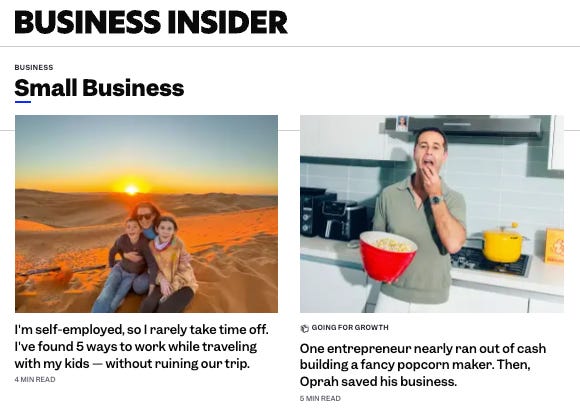
So before you pitch anyone, get really clear on your narrative arc:
Why did you specifically build this?
What were you going through before this company existed?
How are you telling that story right now — on your website, in your bio, on LinkedIn?
If your “about me” reads like a resume, we’ve got work to do. 😅
Start with thought leadership, not press releases
What I actually mean by thought leadership is simple: say something. Say something real, specific, and a little bit brave. Say the thing people in your industry are thinking but nobody’s saying out loud.
Look at Emma Grede.
Her entire brand positioning starts with her own story: who she is, where she came from, what she believes about building businesses and what she doesn’t believe (which is her strongest talking point).
She’s not selling SKIMS or Good American, she’s selling an idea that you should “Start With Yourself” by way of a book.

That’s the move. Figure out your personal narrative first, and let your brand messaging stem from that.
Some questions to get you there:
What do you believe about your industry that most people aren’t saying?
What has your personal experience taught you that’s genuinely useful to others?
What would you talk about even if it never got you a single press mention?
And once you have that — make sure it shows up the same way everywhere. Your Instagram, your LinkedIn, your newsletter, your bio. Not the same caption copy-pasted, but the same point of view.
Okay, now you can pitch… but please do it like this
Here’s the biggest mistake founders make when they finally pitch a journalist:
They pitch their company.
Journalists are not in the business of promoting your startup. They’re in the business of telling stories their readers actually want to read.
So your job isn’t to say “hey, look at us” — it’s to say “hey, here’s a story your audience will love, and I happen to be the perfect person to tell it.”
The trick if you want to do this quickly is a timely angle.
Every good pitch is hooked to something happening right now. Here are three that are wide open at this exact moment:
AAPI Heritage Month — It’s May. Publications are actively looking for founder stories, perspectives on representation in business, and narratives about building as an AAPI entrepreneur. If that’s your story, this is your window.
Summer angles — Seasonal stories are evergreen in the best way. If your business connects to how people spend, travel, work, or live differently in summer, you have an angle. “How I built a business that basically runs itself so I can actually take a real vacation” is infinitely more compelling than “our platform optimizes workflows.”
AI + real results — This is the pitch journalists are drowning in right now, which means most of them are terrible. The ones that actually land are specific and outcome-driven. Not “we leverage AI for efficiency” — but “we used AI to cut our onboarding time by 60%, here’s exactly how.” If you have a real, measurable story about AI changing something in your business, that’s worth pitching. Just make the numbers real and the specifics airtight.
A few ground rules before you hit send:
Keep your pitch under 300 words. Seriously. Cut it down.
Address the journalist by name and reference something they actually wrote (actually read what they write)
Lead with the angle, not the company
Make it easy: a hook, a suggested headline, one line on why their readers will care
(If you already know you need help with this I’m hosting a free training about it next week — [grab your spot here → link].)